
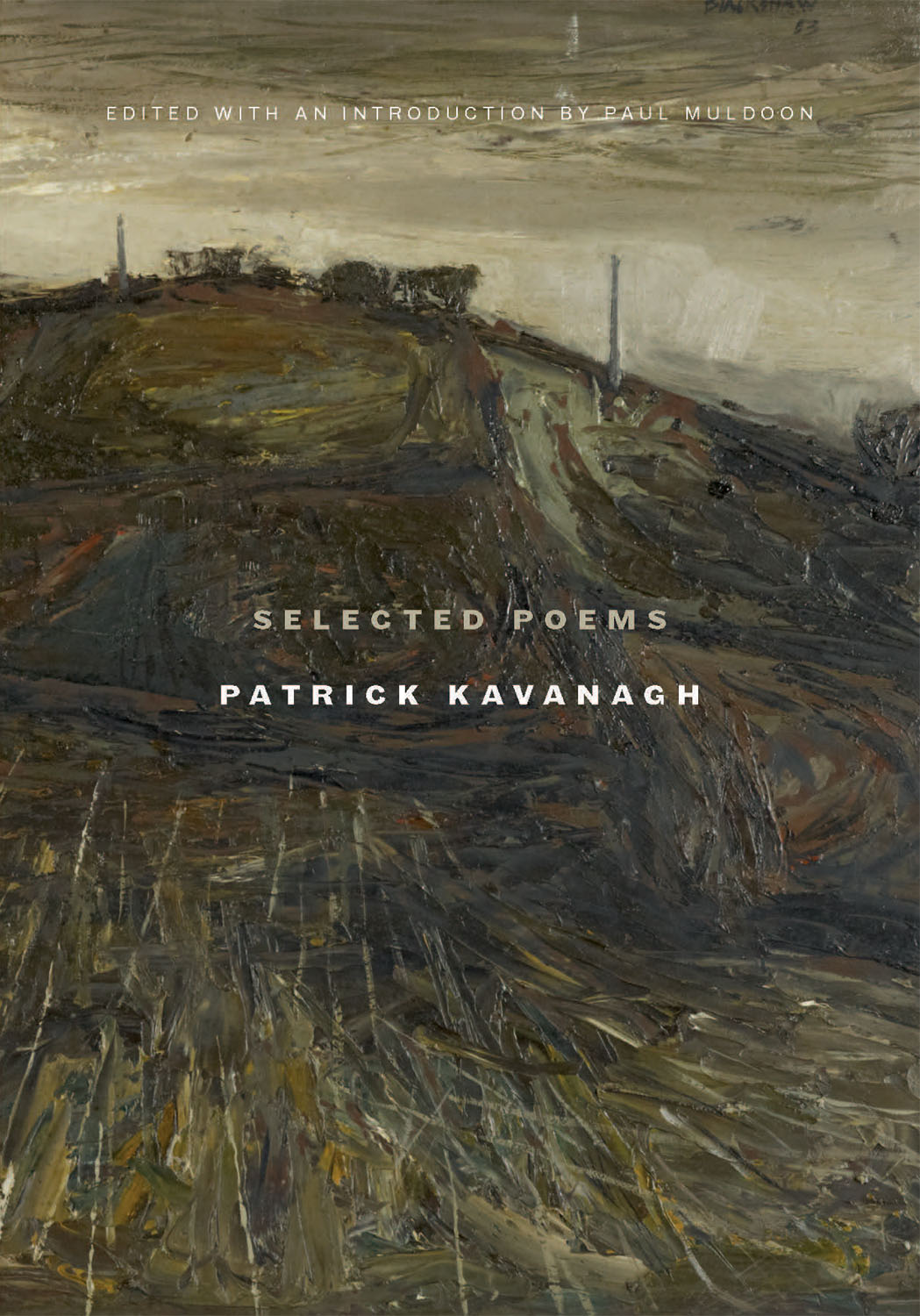
Selected Poems | Patrick Kavanagh
Price range: $11.96 through $17.21
My black hills have never seen the sun rising,
Eternally they look north towards Armagh.
“All Kavanagh’s gifts are on display,” as Paul Muldoon writes in his introduction to this new selection of 40 poems spanning 30 years of Patrick Kavanagh’s career. In truth, these gifts were hard-won, from his earliest self-taught verses after leaving primary school at the age of 13, to his refusal of sanitized pastoral depictions of rural Ireland while living among Dublin’s literary elite, to his transcendent later poems written in the wake of an operation to remove one of his lungs after a cancer diagnosis. Throughout his life, Patrick Kavanagh would carve out a place for himself as one of Ireland’s most important poets with what Muldoon calls “the documentarian’s eye and ear for the everyday technical term.” Gathered here are among his best and best-known poems, beginning with some of his earliest publications in 1930 and continuing chronologically into the 1960s with essentials from his career, as well as highlights left unpublished during his lifetime. The Great Hunger, often considered his major achievement, is presented as a centerpiece alongside Lough Derg, a poem of nearly equal length and possibly equal, though unrecognized, importance. Paul Muldoon presents his selection with a characteristically deft introduction, weaving biographical details into new ways of looking at Kavanagh’s life and lasting legacy of finding “a star-lovely art / In a dark sod.”
From the Introduction by Paul Muldoon
The turnips were a-sowing in the fields around Pettigo
As our train passed through.
A horse-cart stopped near the eye of the railway bridge.
These lines from “Lough Derg” (1942) are archetypical Patrick Kavanagh, combining as they do a matter-of-fact tone with material drawn from the workaday world of rural Ireland. The subject matter of the poem, an account of a pilgrimage to Saint Patrick’s Purgatory, rather tellingly connects Kavanagh to a significant forerunner and a significant heir. The forerunner is William Carleton, author of “The Lough Derg Pilgrim” (1830) and the heir is Seamus Heaney, author of “Station Island” (1984). What’s remarkable about the worlds represented by Carleton, Kavanagh, and Heaney is their almost total continuity and consistency. The life of an Irish peasant, like the life of an English, French, or Dutch peasant, would barely change for hundreds of years. In my own case, I watched my father sow turnips in the 1950s using a horse-drawn turnip barrow of the kind Kavanagh’s farmer must have been using outside Pettigo. When I first visited Dublin, again in the mid-1950s, the streets were notable less for their automobile traffic than the huge number of horse-drawn brewery drays delivering Guinness to an eager public.
Praise for Selected Poems
“Some poets write to discover themselves; others write toward their past selves. Kavanagh seemed to do both.” – Nick Ripatrazone, Catholic Herald
“Muldoon’s selections present the image of a complicated man who was seeking an authentic voice both for himself and his people.” – Joseph A. Mendes, Irish Literary Supplement
Description
My black hills have never seen the sun rising,
Eternally they look north towards Armagh.
“All Kavanagh’s gifts are on display,” as Paul Muldoon writes in his introduction to this new selection of 40 poems spanning 30 years of Patrick Kavanagh’s career. In truth, these gifts were hard-won, from his earliest self-taught verses after leaving primary school at the age of 13, to his refusal of sanitized pastoral depictions of rural Ireland while living among Dublin’s literary elite, to his transcendent later poems written in the wake of an operation to remove one of his lungs after a cancer diagnosis. Throughout his life, Patrick Kavanagh would carve out a place for himself as one of Ireland’s most important poets with what Muldoon calls “the documentarian’s eye and ear for the everyday technical term.” Gathered here are among his best and best-known poems, beginning with some of his earliest publications in 1930 and continuing chronologically into the 1960s with essentials from his career, as well as highlights left unpublished during his lifetime. The Great Hunger, often considered his major achievement, is presented as a centerpiece alongside Lough Derg, a poem of nearly equal length and possibly equal, though unrecognized, importance. Paul Muldoon presents his selection with a characteristically deft introduction, weaving biographical details into new ways of looking at Kavanagh’s life and lasting legacy of finding “a star-lovely art / In a dark sod.”
From the Introduction by Paul Muldoon
The turnips were a-sowing in the fields around Pettigo
As our train passed through.
A horse-cart stopped near the eye of the railway bridge.
These lines from “Lough Derg” (1942) are archetypical Patrick Kavanagh, combining as they do a matter-of-fact tone with material drawn from the workaday world of rural Ireland. The subject matter of the poem, an account of a pilgrimage to Saint Patrick’s Purgatory, rather tellingly connects Kavanagh to a significant forerunner and a significant heir. The forerunner is William Carleton, author of “The Lough Derg Pilgrim” (1830) and the heir is Seamus Heaney, author of “Station Island” (1984). What’s remarkable about the worlds represented by Carleton, Kavanagh, and Heaney is their almost total continuity and consistency. The life of an Irish peasant, like the life of an English, French, or Dutch peasant, would barely change for hundreds of years. In my own case, I watched my father sow turnips in the 1950s using a horse-drawn turnip barrow of the kind Kavanagh’s farmer must have been using outside Pettigo. When I first visited Dublin, again in the mid-1950s, the streets were notable less for their automobile traffic than the huge number of horse-drawn brewery drays delivering Guinness to an eager public.
Praise for Selected Poems
“Some poets write to discover themselves; others write toward their past selves. Kavanagh seemed to do both.” – Nick Ripatrazone, Catholic Herald
“Muldoon’s selections present the image of a complicated man who was seeking an authentic voice both for himself and his people.” – Joseph A. Mendes, Irish Literary Supplement
Additional information
| Binding: | |
|---|---|
| Pages: | |
| Publication Date: |
Related products
-
Sale!

Collected Poems | Thomas Kinsella
Price range: $14.21 through $37.50 Select options This product has multiple variants. The options may be chosen on the product page -

A Hundred Doors
$12.95 Add to cart -

The Ghost Orchid
$11.95 Add to cart -
The Second Voyage
$25.00 Add to cart