
Wake: Up to Poetry
Poem of the Week: “Tortoise Poem” by Leontia Flynn
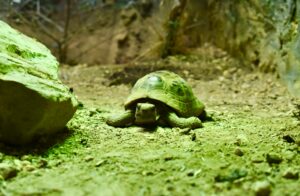
With one of our favorite opening stanzas in recent years, “Tortoise Poem” by Leontia Flynn presents a terrarium as world. Whether the solitary tortoise represents the cultivation of a rich inner life or the increasing isolation caused by the contemporary digital age is up to the reader, however. “Tortoise Poem” belongs to a series of other domestic poems including “Budgie Poem,” “Cat Poem,” and “Houseplant Poem,” each contemplating solitude, privacy, independence, or the relationship between each. The question of solitude is often at the heart of Flynn’s collection Taking Liberties. (Compare the solitude of this poem, for example, with another recent poem of the week, “In Her Silent Cloister.”) At the center of the poem, we find an image that may not be immediately available to American readers, the tortoise’s “Oliver Plunkett head.” Plunkett was a 17th-century martyr and Ireland’s first canonized saint in nearly 700 years. His severed head is a religious artifact and is still on display in a Drogheda church. In the context of the poem, the head is shriveled and grotesque, but it may also be read as an image of isolation, cut off from everything else, or perhaps a means of spiritual ascension.
Tortoise Poem
This large lit tank
is an analog box-TV
tuned to one channel:
tortoise.
All day we’re drawn back
to stare at it.
His paper-bag neck.
His Oliver Plunkett head.
Reverse-Gibraltarian. Extremophile, taking a tour
of the villa boundary, under the glare
of a white, ceramic sun —
unvexed in his breastplate. All the literature says:
a happy tortoise
is a solitary tortoise.
—Leontia Flynn, from Taking Liberties (2026)
Comments are closed.