Wake: Up to Poetry
John McAuliffe in Conversation with Conor O’Callaghan
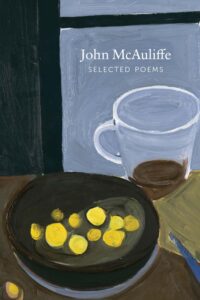
In honor of John McAuliffe’s Selected Poems, we’re revisiting his 2013 interview with Conor O’Callaghan in The Wake Forest Series of Irish Poetry III. In the interview, John McAuliffe discusses writing some of his earliest poems, relocating with his family to Manchester, what it means to write an “Irish poem,” and his relationship to American poetry.
This interview covers his first three collections—A Better Life (2002), Next Door (2007), and Of All Places (2011). Many of the poems discussed below are included in the new Selected Poems, along with others from his two recent collections, The Way In (2015) and The Kabul Olympics (2020). View the Selected Poems table of contents here.
This interview is abridged and edited slightly for clarity. Read the full interview in The Wake Forest Series of Irish Poetry III, which also contains poems and interviews from Colette Bryce, Justin Quinn, Maurice Riordan, and Gerard Fanning.

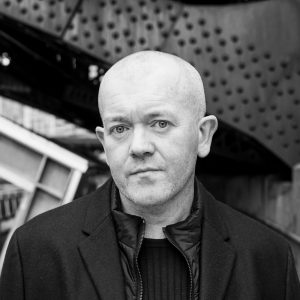
Conor O’Callaghan (photo by Niall Hartnett)
Conor O’Callaghan: What is the earliest poem in this selection? Can you remember when and where it was written, and in what spirit? What do you recall of Ireland and its poetry at the moment of composition, and of how you defined your creative ambitions starting out?
 John McAuliffe: I don’t remember writing “Going Places” but I remember posting it to Poetry Ireland Review when I was a student in Galway, in 1996 or thereabouts. I remember sitting in a cafe on campus trying to figure out which of about eight halfway presentable poems to send there and which to Cyphers, which Eiléan Ní Chuilleanáin edited. I liked her poems and when she wrote me a useful note about the poems, that meant almost as much as getting a letter from Poetry Ireland to say “Going Places” would be published.
I was doing an MA by research in the English Department at the time. There were decades of back issues of Poetry on the shelves and The Hudson Review and The Southern Review, Stand, the TLS, Crane Bag and a fair selection too of twentieth-century American and Irish books (I remember reading a lot of Lowell, Stevens, Ginsberg, Kinsella’s New Poems 1973 and Derek Mahon’s Selected), so I was reading poems, and writing, covertly and in a sort of vacuum, even though Galway was a very lively town for poetry and music around then. When I started, the Waterboys had been based outside Galway for a few years and The Quays pub, where they used to play sometimes, had a tin roof over most of it and buckets around the door for the rain. A couple of years later, that whole derelict area was all cafes and nice pubs.
Over a few years, I saw Seamus Heaney, CK Williams, Derek Walcott, Robert Creeley, Allen Ginsberg read in Nun’s Island or in the refurbished arts center on Dominick Street, and I’d see them afterwards in the smoky bar at the Atlanta Hotel. The first reading I attended, though, was given by Sean Dunne, in the lobby of the university library. A few short years later I saw a note and a photo in the front window of Kenny’s Bookshop on High St. saying that he had died at the age of 39: poetry was a public art in Galway and, I suppose, that chimed with growing up in Listowel too, which had an unusual share of writers living and working in the town.
I wasn’t so conscious of “Irish” poetry then. Reading Kinsella sent me to the Cantos, and Mahon was the source of rumors about Lowell and Wilbur and Stevens. Of the visitors I read a lot of Creeley and CK Williams. And I started going to a monthly workshop in the Bridge Mills, a café/language school by the Corrib in town, where I met Tom French and Rita Ann Higgins (who invited me along) and Anne Kennedy and Eva Bourke, and the social life around the workshops clued me in to a different set of ideas about poetry, and to what might be at stake. Rita Ann and Eva had a real political commitment, in their poems as well as in their way of living and involvement in Galway’s political life. Tom and I read and talked about American and British poetry as much as Irish poetry, I’d say. We were interested in how poems might use traditional forms without sounding traditional, where traditional meant the sort of national poetry and fiction on the university syllabus. I was even more bored with the kind of west of Ireland shtick that got written about Galway and Kerry: so my ambition for the poems was to not do those things; “Going Places” looks out the window and sees not the scenery but the wires crossing it and then dreams up something else, which was part of trying to see things and my relation to them without falling into a stock pattern.
CO: Living there, seeing all of those international poets, must have fed into those many horizons that punctuate A Better Life. Can I ask you to talk a bit about the draw of elsewhere here? I’m thinking especially of poems like “A Good Story,” “Africa,” and “Today’s Imperative.”
JM: Those couple of years in Cork, I was teaching part-time at secondary schools and universities, always on the bus or train from one classroom to another. I felt like I lived elsewhere.
[…]
I wanted to swing the poems away from local turf wars if that makes sense and find another “horizon,” to use your word, for the poems. “A Good Story” and the Horace version both have in mind canons of pastoral poetry, and Irish poetry as a branch of pastoral: I wanted to set the poems at some kind of angle to that, not repeating or just reacting against it. “A Good Story” has a couple of found voices in it, beginning with a bit from the Bible, then a couple of imagined speakers which draws from family lore, my mother’s grandfather’s service in the RIC and the Royal Hong Kong Constabulary: that story probably predisposed me to look out for mongrel versions of what an Irish poem might be. And I wanted the poem, the first poem in the first book, to tell a different kind of national story, while also having an ironic sense of its own fabrications (that it’s a “good story”) across its five-bar stanzas.
The original Horace ode imagines a lot of different places and then decides his own Sabine farm is the best of the lot. I loved the speed with which his poems shifted tone and direction. In “Today’s Imperative,” I replaced his tour of different places with a tour of contemporary poets’ subjects, so the poem has a set of thumbnail sketches of other poets’ work. The poem finishes, like Horace’s, by trying to say that all this might be ok, but that poems can, should pierce or surprise, cut a reader to the quick before they do anything else.
“Africa” turns out to be a variation (another one!) on Patrick Kavanagh’s “Epic.” For me, Kavanagh’s “drills” and “melodeons” were as exotic as Yeats’s Byzantium or Stevens’ “tigers in red weather”: what I loved was how these poets shifted around in their poems, then homed in on recognizable but unsettling returns to the known world. To a particular historical moment. Or to the place of writing or reading. It’s an effect I like, and “Africa” is a poem that uses its title to find an angle on the big evenings of a North Kerry summer: I was interested, like most poets, in setting up unexpected and unlikely relations between places.
CO: Between your first and second books, you settled with your family in Manchester. The book title Next Door seems to refer to England’s proximity to Ireland, as well as the idea of the neighborhood. Did you have that in mind naming the book?
JM: We moved to London in June 2002, just before A Better Life came out. So, while I didn’t have an initial plan or plot for Next Door, the literal break from an Irish to an English context obviously changed the material. After we moved to Manchester in August 2004 I suddenly saw the poems I’d finished in London together and it seemed fairly clear that I had a set of poems which were concerned with combining the two Irish and English settings. Yes I liked trying to reformulate the relation between Ireland and England as neighborly or adjacent, next door, rather than its being oppositional. So the title called attention to that, but I also wanted the title to refer to the family life which the poems draw on. Many of the poems use images from one of those contexts to think about the other, the poems about the children, say, are as likely to feature various borders or flags as the ones about post-industrial English cities will feature children flexibly re-making that world.
As for the strangeness, I did want to decenter the poems, if that makes sense: “There is no capital of the world,” says Miłosz , a line I bore in mind across the book. But I wanted the book’s Irish poems to feel as full of strange detail as the England-set poems, like Han Shan turning up in Páirc Ui Chaoimh in “Clouds,” or those African evangelists appearing by the Feale in “Town.” That placing of things side-by-side, unlike things, but without too much drama, as when you get the Irish seaside town and racecourse venue Tramore alongside the Jewish idea of eruvs and my local Manchester park, Fog Lane, in one sonnet.
[…]
But I was also interested in how British poetry, outside London and with exceptions like Douglas Dunn’s Terry Street and Roy Fisher’s Birmingham, seems very light on the poetry of place, of social or urban places, outside of London or the pastoral anyway. I wanted to lay out Manchester as usable material—I’m not planning on leaving—by writing poems like “The Middle Kingdom,” “A Minute,” and the set of “destruction” poems which begins Next Door, “A Pyramid Scheme,” “Diversion,” and “Moving In,” poems which imagine a kind of reverse colonization. As we moved in, they moved to their holiday homes in the colonies. And I think, I hope, the book sounds equally strange, and maybe exotic, to Irish and non-Irish readers of the poems.
CO: Reading some of the poems of Next Door, I keep thinking of a line from Mahon’s “A Garage in County Cork”: “we might be anywhere but are in one place only. . .” I’m thinking especially of “The Landing” and “The Hundred Towns.” The end of the latter poem has changed since the book: a very Mahonesque thing to do! Can you explain your thinking behind the revision?
JM: I wanted to set down what it felt like to live in a London which seemed comprised of millions of people like me, i.e., the English capital was inhabited by people from other places, the hundred towns of the title. Nancy’s colleagues and our immediate neighbors in London were from all over, the US, Iraq, Iran, Pakistan, Botswana, Somalia, Sierra Leone—and I was teaching classes of teenagers who had blown in from the four corners of the world, all of them plugged into the same daily life but with disorienting hinterlands: one kid missed school because he and his father had been arrested breaking into the Iraqi embassy the day the Allied forces entered Baghdad. There’s freedom, in the poem, in sitting in a park in sunny Greenwich, a feeling that you’re disappearing right there at the center of time, though all the while you’re looking across the Thames at the Canary Wharf towers which the Provos bombed in 1996. Contemporary poetry, and Irish poetry, seemed to go out of focus in those cosmopolitan, global-feeling situations, but then you find there are resources for thinking about this, for asking: How much should you concede to the lure of the present moment? Or must a poem think of itself as historical, as an Irish as opposed to a London poem? It’s a question that hung around in the background of “The Hundred Towns” as I was revising or elaborating on it over 4 or 5 years, and—as Next Door neared completion—I must have felt the need to make that poem a little too thematic and bulldozing and schematic with the book version’s mention of “home,” which the later version here avoids (I hope) while still bearing the theme in mind.
And, yes, that’s a terrific and apt Mahon line, with a sense of potential and limit, a feeling that chimes with “The Hundred Towns” and a lot else in Next Door. A couple of other points of contact with Mahon whose tone and phrasing are still a model to me: I must have had his London poems in view as well in “The Hundred Towns”—I’m thinking of his Kensington poems, more than the brilliant and more recent Coleridge Biographia poem or the Jean Rhys poem which conjures up a more literary London; and Seamus Heaney thinks about the pull of metropolitan fashion in the “District and Circle” sequence as well, though his London train is more decisively homeward bound and funereal.
CO: You seem interested in interruption. The words of some celebrity in “Interview” are cut off at a crucial moment; the asterisked numbers of a credit card form the title of a poem about tax and Wordsworth country; and the beautiful sonnet “You Interrupt” gets interrupted and corrected mid-poem by a loved one.
JM: I’d like to write poems which set different trains of thought in motion and entangle or untangle different images and ideas. And those gaps and interruptions and odd conjunctions are great prompters and inspirations to me and create that sense of change, of being caught off-guard. Not for a purposeful and obfuscatory ambiguity—and god knows there’s plenty of that doing the rounds too—but in a way that keeps faith with the provisionality of writing, with the way poems dart and explore and discover as they explain what’s what. “Basically, there is no difference between understanding and pleasure,” says music critic Charles Rosen—and I like poems which generate that act of understanding, which resist or draw the reader out initially, crossing from one narrowly conceived idiom into something broader and transforming. The idea of having a second speaker in a poem, the one who comes into “You interrupt,” becomes a very useful way of establishing tension and momentum, not so much as a sounding board but as a provocation or skeptical impetus to say more, to be clearer and more convincing, the poem as conversation, with the reader as a kind of omniscient eavesdropper.
When I teach workshops in Manchester I refer students to Proust’s brilliant essay “Against Sainte-Beuve” which discusses the way that certain moments and memories involuntarily catch you or interrupt your sense of “how things are” and force you to sit down and re-examine who and where you are; and those blank spots or blind spots you mention reflect that. The credit card poem came out of re-reading Wordsworth after we moved to his world, the north of England: that poem, and “Interview,” both set up conventional lyric situations (I think) and try to escape from that tick-box form for something that’s more mysterious, private and true, trying out some kind of combination of Wordsworth’s spots of time with what CK Williams notices as “the blank caverns of namelessness we encase.”
CO: The poems here from Of All Places have an even more acute sense of the foreignness of home. “My Adolescence in New Zealand” remembers teenage out-of-place-ness and […] “Aerialist” is that rarest of birds, a genuine Celtic Tiger poem, where Ireland is almost unrecognizable.
JM: Does any writer feel at home “at home”? In Kerry, where those poems are set, there’s an inbuilt foreignness, an inbetweenness to the place still, something I didn’t understand until after I’d moved away: now, driving along the Cork-Kerry border in Sliabh Luachra, I know I’m almost home when I see the signpost for Ó Rathaille’s “stick” (i.e. hedge school). Ó Rathaille, and Eoghan Rua Ó Súilleabháin, are emblematic figures, eighteenth-century poets whose writing lives were split apart by the shift in power and language, but whose changing situations challenge the narratives of many accounts of Irish literature, whether it is Daniel Corkery’s passionate synthesizing account of a single national literature in Hidden Ireland or Thomas Kinsella’s more pessimistic projection of Irish poetries in The Dual Tradition. Hartnett’s “Visit to Croom 1745” takes the Kinsella line, I think, when it travels the west Munster roads only to find the old estate a ruin and it was one model for ‘North Korea’, a poem which also draws on a friend’s description of visiting Pyongyang; also from seeing, in the past few years, the weed-choked estates of new houses built during the boom at home, never lived in and unlikely to find tenants now the boom is over.
The poems also respond to the same idealized and more realist versions of the west […], trying to set down how things actually are and were even as they change around you, in the knowledge that there are wrongheaded and competing versions of this time and place abroad already. The estranging feeling and instability of, odd phrase, returning home, which is, I’d say, part of belonging anywhere, is magnified by bringing North Korea and New Zealand and the poor benighted Byelorussian circus into view in “Aerialist.” The New Zealand poem is also a response to the New Zealand poet Bill Manhire who has published a typically oblique and sudden little poem called “My Childhood in Ireland.”
CO: The title poem [in Of All Places], I recall you saying, is about the carpark in Villanova University in PA. Yes? Did the experience of being in the US, as Heimbold Chair of Irish Studies, have much of an impact on your work? More generally, how familiar or unfamiliar are the noises being made by American poets of our generation?
JM: Yes, the six months in Villanova was a gift—the campus is in Bryn Mawr so we weren’t too distracted by Philly’s bright lights and we had terrible weather so I just hunkered down writing and revising the poems as a group. It’s a longer book, with longer and more strongly narrative poems in it, because of the spell in Villanova.
There are two poems called “Of All Places” in the book: one drills down into the history and prehistory of an unnamed place and the other pans across a lot of places which the poem joins together via those classic universal markers of modernity, the carparks. And the weather, so much snow, makes its way into the book too. I’d been reading Auden before I went, and spent a day or two in nearby Swarthmore reading through his restless drafts and lecture notes, reading his copy of his early poems which he rewrote for the first US edition of his poems: a note on one early poem said “o god what rubbish.” And I visited Thomas and Eleanor Kinsella, who live[d] part of the time in Philadelphia: amazing to walk into their mews house and find the le Brocquy Tain images on the wall, to see the poet at home in his work.
Reading, from outside, you develop a partial canon, a feel for certain useful or useable rhythms so I was looking at new books by August Kleinzahler, Robert Hass, Louise Gluck, Charles Wright, CK Williams, John Ashbery, Rodney Jones, poets I’ve read for a decade or more, and of course reading Muldoon in the US and talking to American poets about his work as a New Jersey-ite was interesting. I was lucky enough to get to know Daisy Fried and Sebastian Agudelo, two younger poets who have an unusual grip on actual day-to-day life and speech in their poems. They’re not just stylists is what I mean, and I’d like to think I’m interested in doing the same kinds of things in poems as they are. With a lot of the other American poets of my age I can’t quite get a handle on the work on its own or maybe on my own terms: I can’t tell whether they are virtuosic variations or just imitations of Ashbery or other American poets whose work I already like, but I do know I can’t read them without reference to those older American poets. I did hear new sounds in Carl Phillips, in the beautiful and unexpected sentences and stanzas of Speak Low. And in Lisa Jarnot’s Night Scenes and Atsuro Riley’s Romey’s Order and I liked the gusto of Matthew Zapruder’s Come On All You Ghosts. I loved Jennifer Egan’s Goon Squad novel and Aleksander Hemon’s stories and Lazarus Project novel. Quick-witted, a little bit messy, direct, and written, or so it seemed, from the thick of their subjects, they make a good argument for writing.
Comments are closed.